What It Costs to Find and Fix a Leak Under a Driveway or Garden
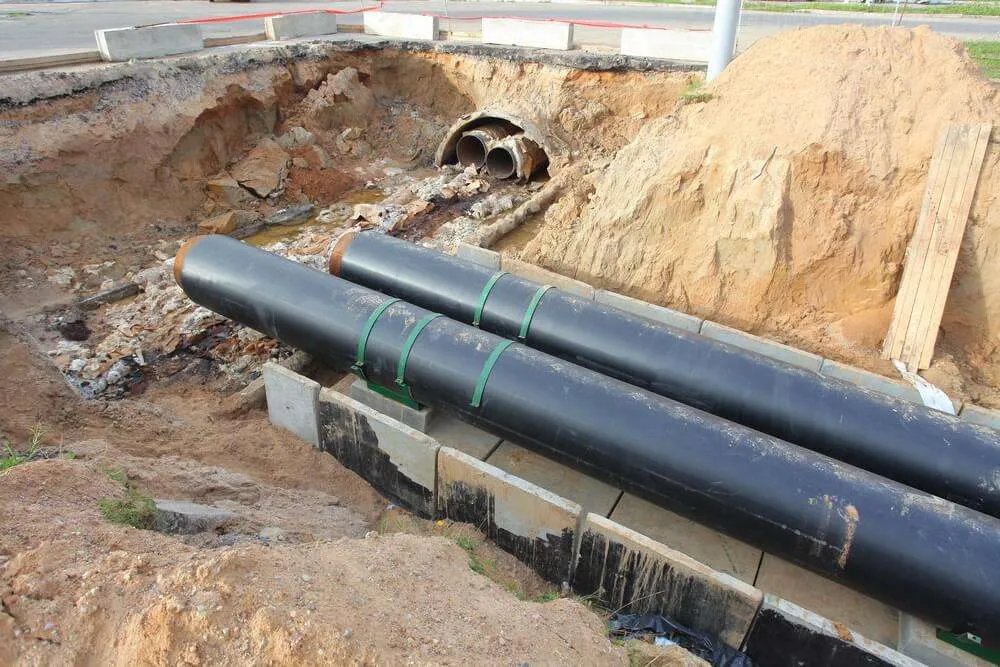
A buried leak produces three invoices, not one, and they are rarely the same size. The detection is usually the smallest of them, and it is the only one that decides how large the other two get.
Three costs that get added together, and should not be
When somebody asks what it costs to fix a leak under a driveway, they are asking about three different things at once. Finding the leak, getting to it, and putting the surface back are separate pieces of work, often done by different trades on different days. Treating them as one figure is why estimates for the same job can differ by four figures.
The point of separating them is not bookkeeping. It is that the first line governs the size of the other two. A leak located to a marked point costs one small excavation. The same leak located to a general area costs a trench, and a trench is priced by the metre in both directions.
| Cost line | What it buys | Who usually carries it | Known when |
|---|---|---|---|
| Detection | Tracing the route, locating and marking the escape, plus the record | Leak detection specialist | Before attendance, from the property and surface |
| Excavation | Breaking the surface and digging down to the pipe | Groundworker or repairing plumber | Once the mark is set and the depth is known |
| Repair or replacement | The pipe itself: a clamp, a section renewal or a full replacement | Plumber or supply pipe contractor | Once the pipe is exposed and the failure is visible |
| Reinstatement | Sub base, surface finish and making good | Paving or surfacing contractor | Once the excavation footprint is final |
On most domestic supply pipe jobs the detection is the smallest of the four numbers and the reinstatement is frequently the largest. That inversion surprises people, and it is the single most useful thing to understand before deciding how much precision is worth paying for.
The boundary decides which length is yours
None of the pricing makes sense until you know which pipe you are talking about. The run from the water main in the street to your tap is not one asset. It is two, with different owners, and the split is not at your front door.
Ofwat's guidance on responsibility for pipes draws it clearly. Water mains are the company's distribution pipes, usually under the highway. Communication pipes carry water from the main to the boundary of the private property and are also the company's. The supply pipe runs from that boundary to the first fitting inside the building and belongs to the property owner, who Ofwat states must maintain it, including detection, repair and replacement.
| Length of pipe | Whose asset | Who pays to find and repair a leak on it |
|---|---|---|
| Water main under the road | Water company | Water company |
| Communication pipe, main to the boundary | Water company | Water company |
| Supply pipe, boundary to first internal fitting | Property owner | Property owner, including any section under a pavement |
| Internal pipework beyond the stop tap | Property owner | Property owner, treated differently again for billing allowances |
The boundary stop tap is the marker, not the front door
Where a company stop tap has been fitted, Ofwat says it normally marks the end of the company's pipework and the start of yours. In practice that is the small chamber in the pavement or verge, and it is the physical point that decides who owns the failure. A leak in the front garden between that chamber and the house is on your side of the line even though it is outside the building.
This matters commercially as well as legally, because it determines whether a survey is an expense you are choosing to incur or one somebody else carries. It also shapes any billing claim, which we cover in the Thames Water leak allowance rules and evidence.
A pipe that crosses someone else's land is still yours
The awkward case in London is the shared or crossing supply. Terraces and converted houses frequently have a single supply pipe serving several addresses, or a pipe that runs under a neighbour's garden or a shared drive before reaching the property it serves. Ownership follows the service, not the soil: the length that serves your property remains your responsibility even where it sits under land you do not own, which is also why access permission becomes part of the job's practical cost. The legal position and the shared supply question are set out in who is responsible for an underground supply pipe leak.
Why a buried run is priced differently from an indoor survey
An indoor survey is largely a process of elimination in a confined space. An outdoor survey on a buried run is a survey of a line that nobody has drawn, under a surface that changes what the instruments can hear, and that difference is what the fee reflects.
The work has two halves that are easy to confuse. The first is tracing: establishing where the pipe actually runs, usually with a pipe locator and a signal applied to the pipe, or by inference from the chamber position and the entry point at the building. The second is locating: finding the escape along that traced route. Tracing has to happen first, because listening along a route you have guessed produces confident readings from the wrong place.
Correlation needs two contact points
Acoustic correlation works by listening at two accessible points on the same pipe and timing the difference in arrival of the leak noise between them. Give it a boundary chamber and an internal stopcock and it can calculate a distance along the run. Take one of those away, and the method loses its geometry: a blocked or buried chamber, a plastic pipe with no metallic path, or a run with an unknown fitting in the middle all degrade the result. Our acoustic leak detection page covers what the equipment can and cannot resolve.
Ground conditions change what the instruments hear
Leak noise travels well along metal and poorly along plastic, well through compacted ground and poorly through loose fill, and it is masked by traffic and by the property's own appliances. The following conditions all lengthen a buried survey and should be flagged before anyone quotes:
- Plastic supply pipe with no traceable metallic path and no accessible metallic fittings.
- A boundary chamber that is buried, seized, flooded or paved over, removing one of the two correlation points.
- A shared supply where several properties draw from the same run, so demand elsewhere masks the leak signal.
- Deep cover, imported fill or a thick concrete raft over the pipe route.
- Heavy traffic, adjacent pumps or a continuous appliance demand that cannot be isolated during the test.
- No known entry point at the building, so the route has to be established from scratch.
Where a run is genuinely untraceable acoustically, the sequence moves on, including tracer gas introduced into the drained pipe. That is slower and involves isolating the supply, which is why it sits later in the order. The method sequence is described in finding a garden or driveway leak without digging the whole run.
What published market figures say about each line
We do not publish our own fee for a buried survey, because it depends on the surface, the route and the access. What is available is third party market data, and it shows the relative size of the four lines clearly.
| Line | Published figure | Source |
|---|---|---|
| Leak detection generally | Average £162, typical £115 to £234, full spread £80 to £1,600; hourly £95 to £145; emergency call out £100 to £120 | Checkatrade water leak detection cost guide |
| Supply pipe repair | Average around £330, with a straightforward burst pipe repair around £220 to £440 | Checkatrade water supply pipe repair cost guide |
| Block paved surface, new | Around £90 to £130 per square metre, averaging about £100 | Checkatrade block paving cost guide |
| Block paving lifted and relaid | In the region of £75 per square metre | Checkatrade block paving cost guide |
Read across that table and the arithmetic of precision becomes obvious. A repair averaging a few hundred pounds sits underneath a surface costing roughly the same for every square metre disturbed. A ten metre exploratory trench through block paving is a reinstatement bill in its own right, incurred whether or not the trench finds anything. The frequently repeated figure of £500 as a UK average for detection appears in no published dataset we can find.
Excavation and reinstatement are usually the larger numbers
Excavation is priced by volume and difficulty, reinstatement by area and finish, and neither is within the leak detection specialist's control once the surface has been opened. What the detection does control is the footprint.
| Surface over the pipe | Excavation difficulty | Reinstatement consideration |
|---|---|---|
| Lawn or planted border | Low, hand dig usually sufficient | Turf and topsoil, visually forgiving, cheapest outcome |
| Gravel over membrane | Low | Membrane and gravel relaid; settlement shows for a season |
| Block paving | Moderate, blocks lift and can be salvaged | Lift and relay is the cheaper route, but colour match on replacements is rarely exact |
| Poured concrete or imprinted concrete | High, breaking out required | A visible patch is unavoidable; matching an imprinted finish is effectively impossible |
| Tarmac or resin bound | Moderate to high | Patch repairs are visible and the joint line is a future failure point |
| Under a structure, wall or outbuilding | Very high | Often drives a decision to reroute the pipe rather than repair in place |
The last row changes strategy rather than price. Where a failure sits under something that cannot reasonably be dug up, the sensible answer is often not to repair the pipe but to abandon the old route and install a new supply along a line that can be reached in future. That is larger on paper and cheaper over the life of the property.
A second failure on the same run is common
Supply pipes rarely fail in isolation. An old galvanised steel or lead run that has corroded enough to perforate in one place is usually close to doing so elsewhere, which is why water companies generally favour replacement over repeated repair and why a third patch on the same pipe is a poor investment. This is also the reason to establish pipe material during the survey rather than after the excavation: material dictates whether repair or replacement is the honest recommendation.
Why one marked point beats an exploratory trench
An exploratory trench is a search method, and the most expensive one available. It is also the least likely to produce a defensible record, because a trench that eventually reaches water proves only that water was there, not where it came from or why the pipe failed.
A located and marked point produces a small excavation, a visible failure, a photograph of the failure mode and a repair that can be inspected. That matters beyond the immediate bill for two reasons. The first is billing: a water company assessing a leak allowance wants an invoice that identifies a repair, and a repair to a specific defect is easier to evidence than a length of replaced pipe found by digging. The second is insurance: where buildings cover is engaged, the insurer is being asked to pay for damage caused by getting to the leak, and the cheaper and more targeted that access, the less argument there is about it.
The limits are worth stating. Detection reduces the excavation footprint; it does not remove it, and no survey can promise a repair without ground being opened. What it does reliably is convert an unbounded cost into a bounded one.
What the water company will and will not do
Householders often assume the water company will attend, find the leak and repair it. On a customer supply pipe that is generally not the position, although there are specific exceptions worth knowing about.
Ofwat notes that companies have particular duties to check supply pipes for leakage when meters are fitted, and to carry out repairs where no further excavation is needed to do the work. That is a narrow window, and it is why a leak discovered at the meter chamber sometimes is dealt with free of charge while an identical leak three metres up the garden is not. Beyond that, most companies operate discretionary schemes with published conditions rather than an open obligation, and those conditions typically cover one repair per property rather than repeated attendance.
Lead supply pipes and replacement schemes
Lead is a separate matter with its own economics. Where the supply pipe is lead, replacement rather than repair is usually the correct answer on water quality grounds as well as reliability, and water companies run replacement programmes that deal with their own side of the boundary. Thames Water sets out its position on lead pipe replacement, including the circumstances in which it will replace its communication pipe and what it expects the property owner to do with the supply pipe. The practical consequence is that a lead supply which has just failed is often the moment to replace the whole run rather than to clamp it, and that a survey which identifies the pipe material has already paid for part of itself.
What to have ready before you ask for a price
A buried survey can be quoted accurately over the phone if the right six things are known. Without them any figure given is provisional, which is the honest description of most numbers quoted sight unseen.
- Whether the property is metered, and what the meter does over a fixed interval with the internal stop tap closed.
- Where the boundary chamber is, whether the lid lifts, and whether it is dry or standing in water.
- The surface between the chamber and the building, and roughly how many metres of it.
- Pipe material if known, from previous work or a visible section in the chamber.
- Whether the supply is shared, and whether the run crosses land belonging to somebody else.
- Whether anything has surfaced: a wet patch, a soft area or unseasonal green growth.
Our fee for a buried survey is fixed, agreed before we travel and quoted separately from any excavation or repair, and we do not publish a number that has not seen the property. Our pricing page sets out how that scoping works, and our underground leak detection service describes the sequence on site, from tracing the route to marking the point. The order that saves the most ground is always the same: confirm the loss, find the pipe, find the leak, then dig once.
How we help with this
If the article describes a problem you actually have, these are the visits that deal with it.
- underground water leak detection
Supply pipe leaks under drives, gardens and pavements.
- leak detection in London
Finding a hidden leak without opening the property up first.
- how our pricing works
What sets the fee for a survey, and what is confirmed before we travel.
Frequently asked questions
Is the leak under my driveway my responsibility or the water company's?
It depends which side of the boundary it sits on. Ofwat's guidance divides the run into company pipes, which are the water main and the communication pipe up to the boundary of the private property, and the supply pipe, which runs from that boundary to the first fitting inside the building and belongs to the property owner. Where a company stop tap has been fitted, that chamber normally marks the dividing line. A leak in your front garden is usually yours even though it is outside the building.
Why is detection quoted separately from digging and reinstatement?
Because they are different trades doing different work, and only the first one is knowable in advance. Detection can be scoped from the surface, the route and the access. Excavation depends on the depth and the surface once the point is marked, and reinstatement depends on the footprint that excavation ends up leaving. Combining them into one figure means pricing the worst case for every client, which is why a single quoted number for finding and fixing a buried leak is almost always provisional.
What do published figures suggest a buried repair costs?
Checkatrade's water supply pipe repair cost guide gives an average of around 330 pounds, with a straightforward burst pipe repair around 220 to 440 pounds. Its leak detection guide gives an average of 162 pounds, a typical range of 115 to 234 pounds and a full spread of 80 to 1,600 pounds. Reinstatement is a separate matter: its block paving guide puts new work at roughly 90 to 130 pounds per square metre and lifting and relaying at around 75 pounds per square metre.
Why does one marked point cost less than an exploratory trench?
Because reinstatement is priced by area and a trench is priced by the metre in both directions. On a block paved drive, every square metre disturbed carries a relaying cost of roughly the same order as the repair itself, and that cost is incurred whether or not the trench reaches the leak. A marked point produces a small excavation, a visible failure that can be photographed, and a repair that an insurer or a water company can evidence. A trench proves only that water was present.
Will the water company find and repair the leak for me?
Not usually on a customer supply pipe. Ofwat notes that companies must check supply pipes for leakage when a meter is fitted and carry out repairs where no further excavation is needed, which is a narrow exception rather than a general duty. Beyond that, most companies run discretionary schemes with published conditions, commonly limited to one repair per property. Ofwat states plainly that householders must maintain their own supply pipes, including detection, repair and replacement.
Should an old lead or galvanised pipe be repaired or replaced?
Replacement is frequently the better answer, and the survey should establish the material before anyone digs. A corroded galvanised steel or lead run that has perforated in one place is generally close to failing elsewhere, so a second or third patch on the same pipe is a poor investment. With lead there is also a water quality argument, and water companies run replacement programmes covering their own side of the boundary. Thames Water publishes its lead pipe replacement position, including what it expects the owner to do.