Subsurface Leak Forensics
Underground Water Leak Detection London
Identifying the source of a subsurface water leak requires a methodical, technology-led approach, as visual inspection is often impossible. The correct diagnostic tool is selected based on property construction, pipe material, and the specific symptoms of water ingress.
Quick answer
An underground supply-pipe leak is traced non-destructively before any digging, using acoustic ground microphones and leak-noise correlators, sometimes with tracer gas or thermal imaging to pinpoint the exact spot. Typical UK trade cost-guide ranges run about £250 to £600. Thames Water may repair a first leak on your boundary or external supply pipe free under its subsidy scheme.
Underground supply-pipe leak detection costs
| Job | Typical cost | Time |
|---|---|---|
| Acoustic ground microphone survey | £250 – £450 | 1 – 2 hours |
| Leak-noise correlator pinpointing | £300 – £600 | 2 – 3 hours |
| Tracer gas detection (hydrogen) | £350 – £650 | 2 – 4 hours |
| Thermal imaging survey add-on | £150 – £350 | 1 – 2 hours |
| Excavation to expose leak (per point) | £400 – £900 | half – full day |
Typical UK trade cost-guide ranges, not a quote. Our detection fee is fixed and agreed at booking.
In Victorian and Edwardian terraces with deep, shared drainage runs, we typically deploy acoustic correlators to pinpoint leaks in cast-iron or clay pipes beneath suspended timber floors. For post-war properties with solid concrete slabs, thermal imaging and tracer gas are more effective for detecting breaches in pressurised copper or MDPE supply lines.
For commercial units, basements, or properties with complex below-ground structures, we integrate moisture mapping with thermal imaging to differentiate between primary leaks and resultant damp migration, ensuring repairs are targeted at the source.
Pricing is project-specific, based on the diagnostic methods required, property size, and access complexity. We provide a fixed-fee quotation following an initial assessment.
What you get
- Acoustic correlation for precise location of leaks under timber floors or in deep drainage runs, filtering out ambient building noise.
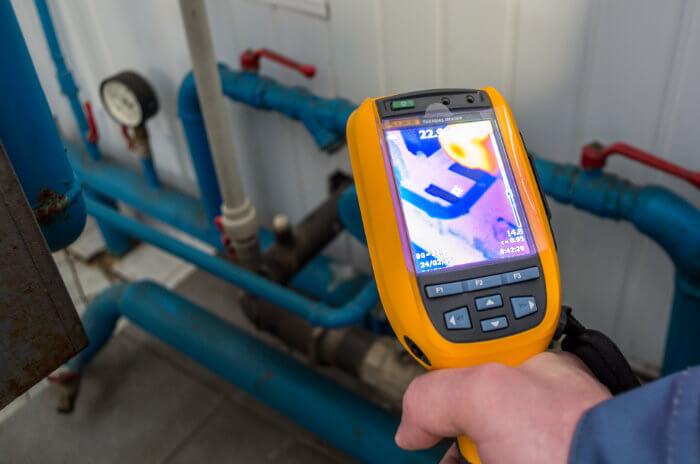
- High-resolution thermal imaging to identify thermal anomalies in concrete slabs and behind finishes, indicating cooler water paths.
- Tracer gas (hydrogen/nitrogen mix) injection for non-destructive testing of pressurised systems and complex, multi-layer substrates.
- Non-invasive moisture mapping using capacitive and resistance sensors to delineate the extent of water migration from the source.
- Diagnostic reports include annotated thermograms, acoustic signatures, and moisture maps for contractor instruction or insurance evidence.
- Method selection is guided by an initial site assessment of pipe access points, construction type, and pressure test results.
How it works
A method, not a guess
01
Initial Diagnostic Assessment
We conduct a site survey to review construction plans, identify accessible pipework, and perform initial pressure tests to confirm a leak and isolate the affected section.
02
Technology Selection & Deployment
Based on the assessment, the optimal combination of acoustic, thermal, or tracer gas equipment is deployed to survey the target subsurface zone.
03
Data Acquisition & Analysis
Our engineers capture and cross-reference datasets on-site, such as correlating acoustic peaks with thermal anomalies, to validate the leak location.
04
Reporting & Verification
We provide a technical report detailing the diagnosed source, recommended access point, and method verification. A post-repair pressure test can be arranged to confirm resolution.
Before you book anyone
Six things to know before you book underground water leak detection in London
01
Do the free stopcock test before you pay anyone
Ten minutes of your time can confirm the leak is genuinely underground. Turn off the internal stopcock, run no water, and watch the meter at the boundary. If the dials keep turning with the stopcock closed, water is escaping between the meter and your house - the classic buried supply pipe leak. If the meter stops, the problem is inside and a standard survey applies instead. Water companies flag continuous flow on smart meters (one Thames Water letter cited 48 litres per hour, roughly ten times normal household usage), so this test also tells you whether their letter is accurate before the four-week repair clock starts running.
02
Hourly rates are where underground jobs get expensive
Trade platforms quote leak detection at £95-£145 per hour, which sounds cheap next to a fixed survey fee. But underground supply pipe leaks are rarely a one-hour job: the pipe must be isolated, pressure tested, charged with tracer gas and traced along its full run, often under driveways or extensions. Day rates for complex traces run £595-£1,500, and hidden-leak investigations typically land between £425 and £695. An open-ended hourly clock means you carry all the risk of a slow trace. A fixed fee agreed before the visit - our detection surveys run £250-£450 for typical London homes - caps that risk at booking.
03
Read the no-find-no-fee small print - underground leaks are often excluded
Many firms advertising no find, no fee quietly exclude exactly the leak you have. Common carve-outs in published terms: the guarantee applies to internal hot and cold pipework only, with incoming mains and underground supply pipes excluded; "found" is defined as narrowing the leak to a 5m x 5m area rather than a dig-here point; and the guarantee is void unless the same firm carries out the access work. Before booking, ask three questions in writing: does no-find-no-fee cover the external supply pipe, how precisely will the leak be marked, and is the guarantee conditional on you buying the repair from them?
04
Ask what equipment actually arrives on the van
Buried supply pipes cannot be reliably traced with a thermal camera alone - soil masks temperature differences, and plastic MDPE pipe transmits sound poorly, which defeats basic listening sticks too. A proper underground trace needs tracer gas (the industry-standard 5% hydrogen, 95% nitrogen mix, non-toxic and non-flammable) pushed through the isolated pipe so escaping gas can be detected at the surface, backed by acoustic correlators and a pressure test to confirm the circuit. Done properly, this pinpoints leaks to within centimetres. If a company cannot list the methods they will bring, you are paying survey money for a guess.
05
Never accept a dig-first quote - excavation is the expensive part
Speculative digging is the most common way London homeowners overpay. Trenching costs roughly £100-£200 per metre once reinstatement of drives and paving is included, moling runs £150-£200 per metre, and a full supply pipe replacement averages around £3,200 (£1,200-£4,400+ depending on length and access). Forum threads are full of invoices for exploratory holes dug in the wrong place - one repair bill for an underground lead pipe came in at over £1,600. Pinpointing the leak before anyone lifts a slab means one targeted excavation, or the cheaper decision to mole a new pipe instead of patching an old one repeatedly.
06
Mind the four-week deadline - and get a report your insurer and water company will accept
Most water companies, including Thames Water, only credit a leak allowance for water lost through a supply pipe leak if it is fixed within about four weeks of notification - miss it and you can be billed for every litre, with metered leak bills reaching £4,000 in reported cases. Around 97% of UK buildings policies also include trace and access cover, typically £5,000-£10,000, but loss adjusters reject vague paperwork. Insist on a written report stating cause, origin, detection method, moisture readings and photographs. We issue trace and access reports structured for UK loss adjusters within 48 hours of the survey.
Compare like for like
Underground Water Leak Detection Across London
A hidden leak on your underground supply pipe can waste water, soak foundations and inflate your bills long before it surfaces. We trace the exact leak position with acoustic ground microphones and correlators before anyone lifts a slab, so any digging is small, targeted and only done where it is genuinely needed.
| What to check | A cheap hourly quote | A dig-and-hope firm | London Leak Specialist |
|---|---|---|---|
| Finding the leak first | Quotes a low hourly rate but often starts digging early, letting the clock and the trench run on with no clear leak position confirmed. | Relies mainly on excavation, opening the ground where the pipe is assumed to run rather than where the leak has actually been traced. | We trace the leak with acoustic ground microphones and correlators along the supply pipe route, pinpointing the position before any ground is opened. |
| Who is responsible | Rarely checks the water company boundary, so you may pay for a leak that is not legally yours to repair. | Focuses on digging, not on establishing whether the leak sits on your supply pipe or the company's main. | We help establish where the boundary falls and whether the leak is on your supply pipe or the water company's side before work proceeds. |
| Free repair schemes | Seldom mentions that many London water companies offer a first free repair on customer supply pipes under set conditions. | Tends to quote for full excavation without raising any subsidy you might be entitled to claim. | We flag whether your water company's first-leak repair subsidy may apply, so you can claim any free repair you qualify for. |
| How pricing works | An open hourly rate can climb quickly once unexpected digging, reinstatement and extra hours are added on the day. | Excavation-led pricing is hard to predict, as cost depends on how much ground is opened to find the pipe. | We quote clearly against typical UK trade cost-guide ranges for detection, so you understand the likely cost before we begin. |
| If nothing is found | You usually still pay the accrued hours even if no leak is located during the visit. | You may pay for excavation and reinstatement whether or not the leak is actually found where they dug. | We work on a no-find, no-fee basis for detection, so you are not charged for a survey that fails to locate the leak. |
| Amount of digging | Early or speculative digging can mean several trial holes across your garden, drive or floor before the leak is reached. | Dig-and-hope means opening larger stretches of ground on the chance of exposing the leaking section. | Because the position is traced first, any excavation is kept small and targeted to the confirmed leak point only. |
| Report for your insurer | Often provides little more than a verbal summary, which insurers may not accept for a claim. | Usually leaves you with a repair invoice but no evidence of how or where the leak was located. | We provide a written detection report with our findings and method, suitable for supporting a home insurance claim. |
From the forums
What Londoners say on Reddit & forums
Search UK forums like MoneySavingExpert, Reddit's r/DIYUK and r/AskUK for supply pipe leaks and the same stories repeat: alarming smart-meter letters, four-figure water bills, disputed invoices and confusion over who owns the pipe. Here is what homeowners consistently report - and what it means for you.
On MoneySavingExpert's water board, homeowners receiving Thames Water "you may have a leak" letters
The recurring pattern is a smart-meter letter flagging continuous flow - one poster's account showed over 4,000 litres a day against a normal 400 for a three-person household - followed by panic about the repair deadline. Experienced posters urge people to accept the water company's free investigation visit first, then act fast because the leak allowance depends on a prompt fix. One homeowner even found the leak had been repaired the day before the letter was posted. Our take: treat the letter as a deadline, not a diagnosis - verify with a stopcock test, then book a proper trace within days, not weeks.
Forum threads on shared supply pipes in terraced London streets
Victorian terraces often run one supply pipe across six or more properties, and threads show how messy this gets: a leak surfaces under one neighbour's extension, their plumber repairs it, and the invoice lands on someone else's doormat - sometimes alongside a formal Section 75 notice from the water company demanding repair. The consensus advice is to check the deeds, establish exactly which section of pipe failed, and never pay an invoice for a leak nobody has proven is on your section. Our take: an independent trace that maps the leak position against pipe ownership is the cheapest way to settle these disputes before they turn legal.
Money-saving forum discussions about leak allowances and huge metered bills
Posters report six-month bills approaching £4,000 from a single underground leak, but also successful outcomes - refunds credited within a week of proving the leak was fixed. The community's rule of thumb is blunt: if you don't ask, you may not get. Fewer people know the detail that supply pipe allowances can usually be claimed more than once, while internal pipework allowances are typically a one-off. Our take: keep the detection report and repair invoice, because the allowance claim stands or falls on documented proof of what leaked, where, and when it was fixed.
Homeowners disputing plumber invoices for underground leak work
A common grievance is paying for excavation that missed the leak - one poster found the repaired spot was six feet from where the first engineer said the leak was, and others describe exploratory holes billed by the hour with nothing found. Forum regulars consistently advise getting an independent assessment before paying disputed invoices and checking the tradesperson is actually qualified for water supply work. Our take: this is precisely why detection and repair should be separated - pinpoint first at a fixed cost, then get the repair quoted against a known dig location.
Threads on whether the water company will fix the pipe for free
Plenty of posters still believe the water company must repair a leaking supply pipe, and are surprised to learn the pipe from the boundary to the house is legally theirs. Thames Water withdrew its free first-repair scheme back in 2008, and current help is limited to financial assistance schemes for eligible low-income customers - though several posters noted companies sometimes repair leaks on the public side, pavement digs included, at no charge. Our take: establish which side of the boundary the leak sits before spending anything, because if the meter shows flow with your stopcock open but the leak is upstream of the boundary, it is the water company's bill.
Questions
Asked before every booking
Why can't you give a single price for underground leak detection?
The cost is dictated by the technology required. A simple acoustic trace on an accessible pipe run is less involved than a multi-day tracer gas survey in a reinforced concrete basement. We scope the technical requirement first.
Which method is best for a leak under a solid concrete floor?
Thermal imaging is primary for visualising temperature differentials caused by leaking water. If the leak is very slow, tracer gas is often used in conjunction, as it migrates to the surface through cracks and joints, where it is detected by a sensitive sensor.
How do you differentiate a main supply leak from a drainage issue?
Supply leaks under pressure typically produce detectable acoustic signatures or cause localised cooling. Drainage leaks often manifest with slower, odorous water ingress; we use drain cameras and moisture mapping to trace the path back to the failed joint or pipe.
Can you detect leaks under basement tanking or waterproofing membranes?
Yes, but it requires an integrated approach. Thermal imaging can show cooling patterns on the membrane surface, while tracer gas injected into the cavity behind the membrane will pinpoint the breach location without destructive investigation.
What information do you need before a survey?
Provide any available property plans, details of recent works, and the location of known stop taps and inspection chambers. This allows us to pre-select the most effective technology and minimise on-site diagnostic time.
How much does underground water leak detection cost in London?
Expect £250-£450 for a fixed-fee multi-method survey of a typical London home, agreed before the visit. Hourly-rate firms charge £95-£145 per hour, which on underground supply pipe traces commonly totals £425-£695, with complex day-rate jobs reaching £595-£1,500. Detection is priced separately from repair: excavation and pipe work run from a few hundred pounds for a single targeted dig to around £3,200 on average for full supply pipe replacement.
Who is responsible for an underground water leak between the meter and the house?
The homeowner. The water company owns the main and the communication pipe up to the boundary of your property (usually the external stop valve or meter). Everything from the boundary to your internal stopcock is your private supply pipe, and leaks on it are yours to repair - typically within about four weeks of the water company notifying you. Leaks on the public side, including under the pavement, are the water company's responsibility to fix at no charge.
Will my water company refund the water lost through a leak?
Usually yes, through a leak allowance - but only if you act quickly. Most companies, including Thames Water, credit water lost through a supply pipe leak provided you repair it within roughly four weeks of being notified. Supply pipe allowances can generally be claimed more than once; internal pipework leaks are typically allowed only once. You will need proof of repair, such as a detection report and plumber's invoice, so keep all paperwork.
How long does underground leak detection take?
A typical domestic underground trace takes two to four hours on site. The pipe is isolated and pressure tested first to confirm the leak is on that circuit, then tracer gas (5% hydrogen, 95% nitrogen) is introduced and traced at the surface alongside acoustic correlation - the gas stage alone can pinpoint a leak in under an hour. Larger properties, long pipe runs or leaks under extensions take longer. Written reports for insurers or the water company usually follow within 48 hours.
How accurate is underground water leak detection?
Very accurate when multiple methods are combined. Tracer gas surveys locate buried leaks to within centimetres, with industry sources citing success rates above 95%, and acoustic correlators cross-check the position along the pipe run. Beware looser definitions: some firms' terms class a leak as "found" once narrowed to a 5m x 5m area, which can still mean digging several exploratory holes. Ask any company how precisely they will mark the excavation point before you book.
Does home insurance cover underground leak detection?
Usually, via trace and access cover, which around 97% of UK buildings policies include with limits of £5,000-£10,000. It pays for locating the leak and accessing the pipe - excavating and reinstating floors or driveways - but not the pipe repair itself or pre-existing damage. Claims succeed on paperwork: insurers expect a report stating the cause, origin, detection methods used, moisture readings and photographs. Check your policy schedule before booking, and get the detection report before repairs start.
London-wide
Covering all 33 boroughs
Related services
Acoustic Detection
Ground microphones and correlators read the sound a pressurised leak makes through masonry, screed and Victorian pipework across London properties.
Learn moreTracer Gas
Hydrogen and nitrogen tracer gas reaches what sound cannot: screeded UFH loops, buried supply runs and low-pressure pipework in London buildings.
Learn moreLeak Repair
The fault is located with detection equipment before any repair begins, which is why the opening is small and the reinstatement is predictable.
Learn moreWater going somewhere it shouldn’t?
Tell us the symptoms and your postcode. We’ll confirm the visit, the fixed detection fee and the arrival window before you commit to anything.
Book a detection visit