Acoustic vs. Thermal vs. Tracer Gas: A Technical Guide to Leak Detection Methods
We compare the technical principles, precision, and ideal applications of acoustic, thermal imaging, and tracer gas leak detection for property professionals.
Technical Principles of Modern Leak Detection
For landlords and commercial facilities managers, pinpointing a leak's exact source is critical to minimising damage and repair costs. Modern leak detection moves beyond guesswork, employing specialised technology to locate breaches with precision. The three primary methodologies—acoustic, thermal imaging, and tracer gas—operate on distinct physical principles, each suited to specific scenarios. Understanding these core technologies allows for the correct deployment of resources, ensuring a swift and non-invasive resolution.
Acoustic Leak Detection: Listening for the Signal
Acoustic detection is the most direct method for locating pressurised water leaks within pipes. Our engineers use ground microphones and advanced correlators to detect the specific sound frequency, or 'noise', created by water escaping under pressure. This sound transmits through the pipe material and the surrounding soil or structure. A correlator calculates the time delay of the sound arriving at two sensors, providing a precise distance to the leak point, often to within a metre.
This method is highly effective for metallic and PVC mains supply pipes, especially under concrete slabs or in buried services. Its success relies on a pressurised system and can be less effective on non-pressurised drains or in areas with high ambient noise interference. For commercial properties with complex pipework networks, acoustic correlation provides a reliable first line of technical investigation.
Thermal Imaging (Infrared) Surveys: Visualising Temperature Anomalies
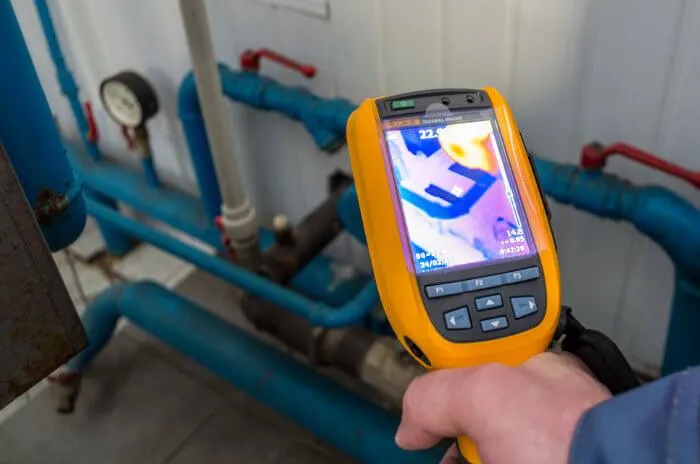
Thermal imaging cameras detect infrared radiation to create a visual map of surface temperatures. In leak detection, this technology identifies anomalies caused by moisture. Escaping water from a leak typically alters the thermal mass of building materials; a wet area will often appear cooler (or sometimes warmer) than its dry surroundings on a thermal scan.
Our surveyors use thermal imaging for non-invasive screening of underfloor heating systems, identifying damp patches in walls and ceilings, and tracing the extent of water ingress. It is exceptionally useful for locating leaks in underfloor heating manifolds or within screed, and for verifying the dryness of a structure post-repair. Crucially, it is a passive technique, measuring only surface temperatures, and requires a temperature differential between the leak water and its surroundings to be effective.
Tracer Gas Detection: The Ultimate Precision Tool
When other methods are inconclusive—particularly for non-pressurised pipes, complex underground runs, or in highly noisy environments—tracer gas detection offers unparalleled precision. The process involves purging the suspect pipe and introducing a safe, inert gas mixture, typically 5% hydrogen and 95% nitrogen. This gas, lighter than air, will escape at the point of the leak.
Our technicians use highly sensitive gas detectors to 'sniff' for the tracer gas at the surface. The detector provides both an audible and visual indication of gas concentration, allowing us to trace the leak path and pinpoint the exact exit point, often to within centimetres. This method is the gold standard for locating leaks in under-slab drainage, ventilation pipework, and hard-to-access central heating systems, causing zero damage during the investigation.
Selecting the Correct Detection Methodology
The choice of technology is dictated by the leak scenario. For a suspected pressurised mains water leak under a warehouse floor, we would typically initiate an acoustic correlation survey. For investigating a mysterious damp patch on a ceiling, a thermal imaging survey provides a broad visual assessment. For a suspected breach in a buried drainage run beneath a landscaped area, tracer gas detection delivers the pinpoint accuracy required for a targeted excavation.
Our engineers are trained across all three disciplines. We often employ a combination of methods in a logical sequence to confirm findings, ensuring the diagnosis is technically robust. For property professionals, this multi-method approach translates to reduced investigative damage, accurate repair quoting, and a definitive solution to water loss and damage.
Frequently asked questions
Which leak detection method is the most accurate?
Accuracy is context-dependent. Tracer gas detection typically offers the highest spatial precision, often locating a leak to within centimetres, making it ideal for complex or non-pressurised systems. Acoustic correlation provides excellent accuracy for pressurised water pipes. The 'most accurate' method is the one correctly matched to the specific pipe material, system pressure, and environmental conditions of the leak.
Can thermal imaging detect leaks inside walls?
Yes, thermal imaging can detect signs of leaks inside walls by identifying temperature anomalies on the wall surface caused by moisture. It does not 'see through' walls but visualises the thermal effects of water ingress. This makes it an excellent non-invasive tool for mapping the extent of damp and guiding further investigation, though it may not pinpoint the exact pipe breach location like tracer gas can.
When is acoustic leak detection not suitable?
Acoustic detection is less effective on non-pressurised systems (like most waste drains), on pipes with low pressure or very slow leaks, and in environments with high ambient noise interference (e.g., near heavy machinery or traffic). It also requires good acoustic coupling to the pipe, which can be challenging with certain pipe materials or deeply buried services. In these cases, tracer gas or thermal imaging are preferable investigative tools.